Supporting materials
English translations of awards and conference materials, plus a summary of the published article and a guide to the research figures. Document translations are unofficial.
Upper Kostinskaya carbonate reservoir
Artur R. Zhabyak. “Structure of the Upper Kostinskaya Reservoir on the Sukhotungussky Ridge and Controls on Prospective Hydrocarbon Traps.” Paradigma, 2026, No. 7.3, pp. 78–90. ISSN 2367-8658.
The study refines the structure of a carbonate reservoir on the western Siberian Platform. Well-log correlation, well tests, core and seismic data support a fold-and-thrust interpretation. The work identifies local structural closures and examines the role of faults, reservoir properties and secondary porosity in trap development.
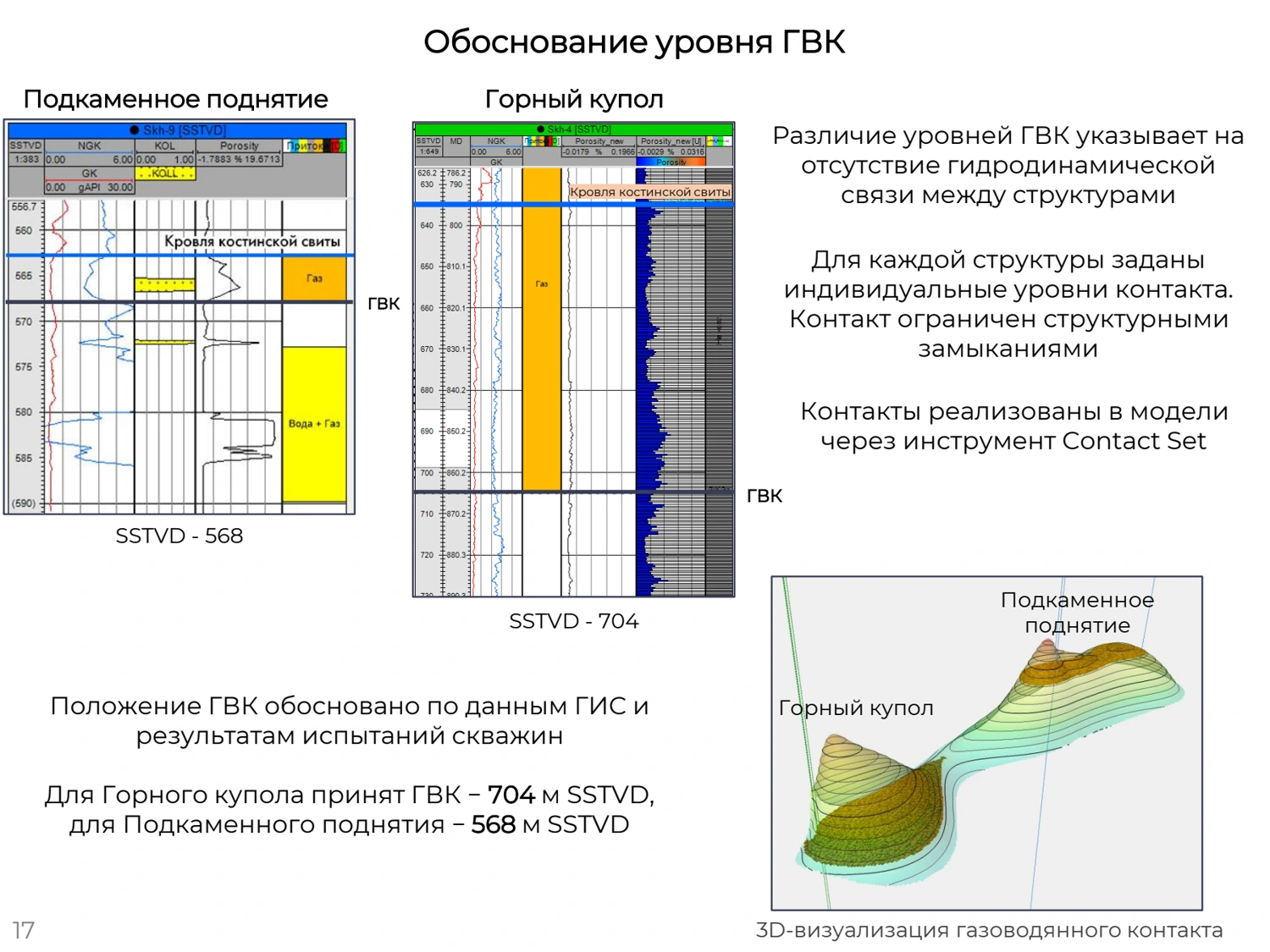
The related master's project extends the interpretation to a 3D reservoir model and volumetric estimate. It uses six seismic lines and logs from ten wells. Test and log evidence supports separate gas–water contacts for the Gorny Dome and Podkamennoye Uplift. The combined model estimate is 1.13 billion m³ gas initially in place.
Read the Petrel case study · Original journal article (Russian)
Publisher's certificate
This certifies that Artur Ruslanovich Zhabyak's article “Structure of the Upper Kostinskaya Reservoir on the Sukhotungussky Ridge and Controls on Prospective Hydrocarbon Traps” was approved for publication in the electronic scientific publication Paradigma, No. 7, 2026, with subsequent indexing in the Russian Science Citation Index, as stated in the certificate.
Publisher's confirmation
The journal confirms that A. R. Zhabyak's article on the Upper Kostinskaya reservoir and prospective traps was approved for publication in Paradigma, No. 7, 2026. The letter states that journal issues are included in the eLIBRARY.RU scientific electronic library and indexed in the Russian Science Citation Index. Signed by Editor-in-Chief A. L. Fursov.
Best Practice award
Winner's diploma awarded to Artur Ruslanovich Zhabyak in the Best Practice category at the 9th Scientific and Technical Conference of Irkutsk Oil Company. Irkutsk, 2025. Signed by N. M. Buynov, Executive Director and Chair of the Board, and D. V. Levin, General Director.
Special Jury Prize
Diploma awarded to Artur Ruslanovich Zhabyak in the Geological Exploration section, Special Jury Prize category, at the 13th Young Professionals Scientific and Technical Conference of the Gazprom Neft Science & Technology Center. Signed by A. A. Vashkevich, Deputy Head of Technology Development for Exploration and Production. 2024.
Earth Sciences: Current State
Certificate of participation awarded to Artur Ruslanovich Zhabyak at the 7th All-Russian Young Researchers' Scientific and Practical School-Conference “Earth Sciences: Current State.” Shira, Republic of Khakassia, 2024. Signed by V. A. Vernikovsky, organizing committee chair, dean of the NSU Department of Geology and Geophysics, and member of the Russian Academy of Sciences.
Correlation of Vendian and Cambrian strata
English translation of the conference abstract. A. R. Zhabyak, Novosibirsk State University and the Siberian Research Institute of Geology, Geophysics and Mineral Resources, Novosibirsk. ISSC 2023, Geology section, p. 88. UDC 553.98.
The study area is on the Siberian Platform. It forms part of the Turukhano–Norilsk Ridge and covers the northern Kureika–Baklanikha Megauplift, including the Sukhotungussky Ridge. It borders the Suringdakon High to the east, the Severorechensk High to the north and the West Siberian Platform to the west. In petroleum-geological terms it lies in the Turukhano–Norilsk petroleum region of the Lena–Tunguska petroleum province.
Most exploration for oil and gas took place from 1960 to 1990. Core holes and deep wells were drilled, and seismic surveys identified the Sukhotungussky Ridge as a prospective structure. In 2017–2020 geophysical surveys were run along the Tynepskaya–Khantayskaya well profile, which crossed the ridge in a roughly north–south direction.
Petroleum potential in the Kureika–Baklanikha Megauplift is associated with Vendian, Lower Cambrian and Middle Cambrian strata. Traps occur on the second-order Sukhotungussky Ridge, where three local structures stand out: the Dyavolskoye Uplift, Gorny Dome and Podkamennaya Anticline. The proposed hydrocarbon source is the Riphean Lower Tunguska source kitchen.
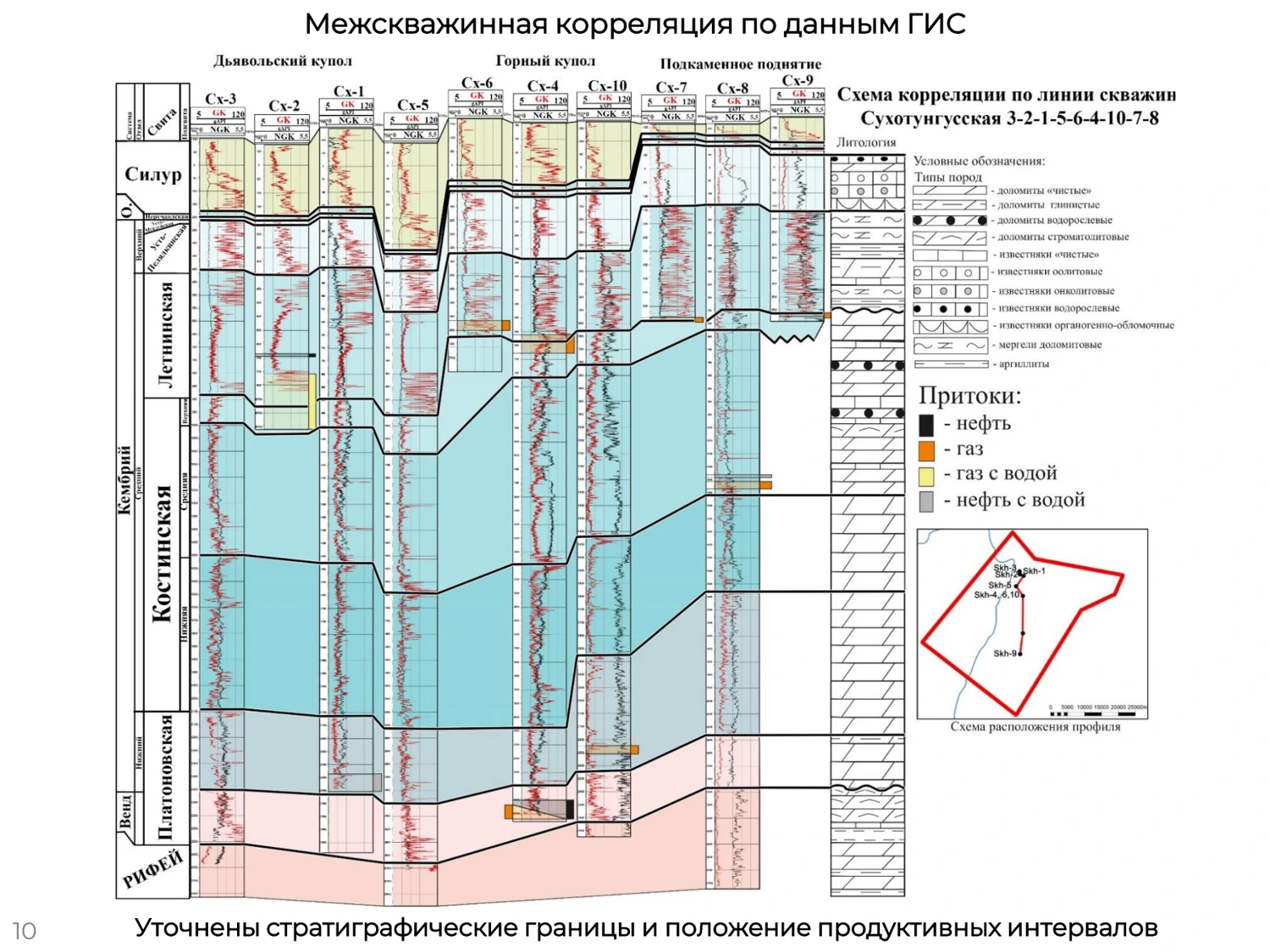
To assess petroleum prospects, I examined deep-drilling results, subdivided the well sections by lithology and correlated Vendian and Cambrian strata in Petrel. The resulting stratigraphic picks were revised for use in structural mapping.
Reference. T. K. Bazhenova and V. I. Kazais, “Hydrocarbon Generation and Accumulation in the Northwestern Siberian Platform: Historical, Geochemical and Structural Analysis,” Petroleum Geology: Theory and Practice, 2011, vol. 6, no. 2. Supervisor. M. A. Maslennikov, Candidate of Geological and Mineralogical Sciences.
Original abstract (Russian, PDF) · Conference proceedings (Russian)
NSU letter of appreciation · 2024
Awarded to Artur Ruslanovich Zhabyak for active engagement, productive work and a substantial contribution to the academic, community, cultural and social life of Novosibirsk State University. Signed by Mikhail Fedoruk, NSU Rector and member of the Russian Academy of Sciences. Novosibirsk, December 2024.
NSU letter of appreciation · 2023
Awarded to Artur Ruslanovich Zhabyak for active engagement, productive work and a substantial contribution to the academic, community, cultural and social life of Novosibirsk State University. Signed by Mikhail Fedoruk, NSU Rector and member of the Russian Academy of Sciences. Novosibirsk, December 2023.
NSU letter of appreciation · 2022
Awarded to Artur Ruslanovich Zhabyak for active engagement, productive work and a substantial contribution to the academic, community, cultural and social life of Novosibirsk State University. Signed by Mikhail Fedoruk, NSU Rector and member of the Russian Academy of Sciences. Novosibirsk, December 2022.
Composite seismic section
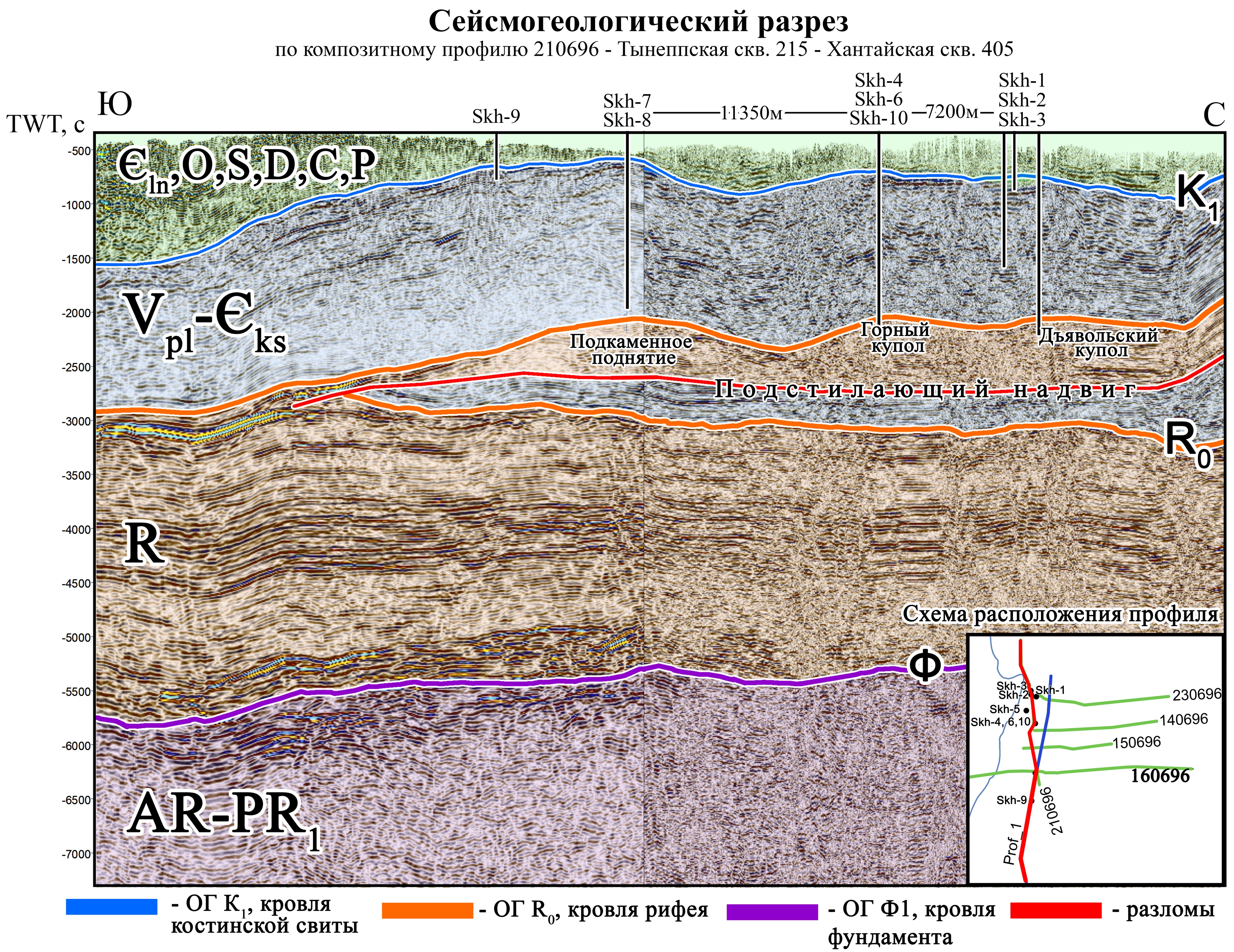
The section follows line 210696 and the profile through Tynepskaya well 215 and Khantayskaya well 405. From south to north the interpreted structures are the Podkamennoye Uplift, Gorny Dome and Dyavolsky Dome. The vertical scale is two-way travel time. The inset locates the profile and adjacent seismic lines.
Legend. Blue marks the reflector at the top of the Kostinskaya Formation. Orange marks the top of the Riphean interval, magenta the top of basement, and red marks faults. The section also shows the interpreted thrust and the well ties.
Well-log correlation
The panel correlates the Sukhotungusskaya wells across the Dyavolsky and Gorny domes and the Podkamennoye Uplift. Stratigraphic picks trace the units from the Riphean section through the Platonovskaya, Kostinskaya and Letninskaya intervals into the Silurian section.
Test legend. The original inflow symbols distinguish oil, gas, gas with water, and oil with water. The lithology column distinguishes carbonate varieties and fine-grained intervals. The inset shows the order and position of the wells along the correlation line.
Structural framework and layering
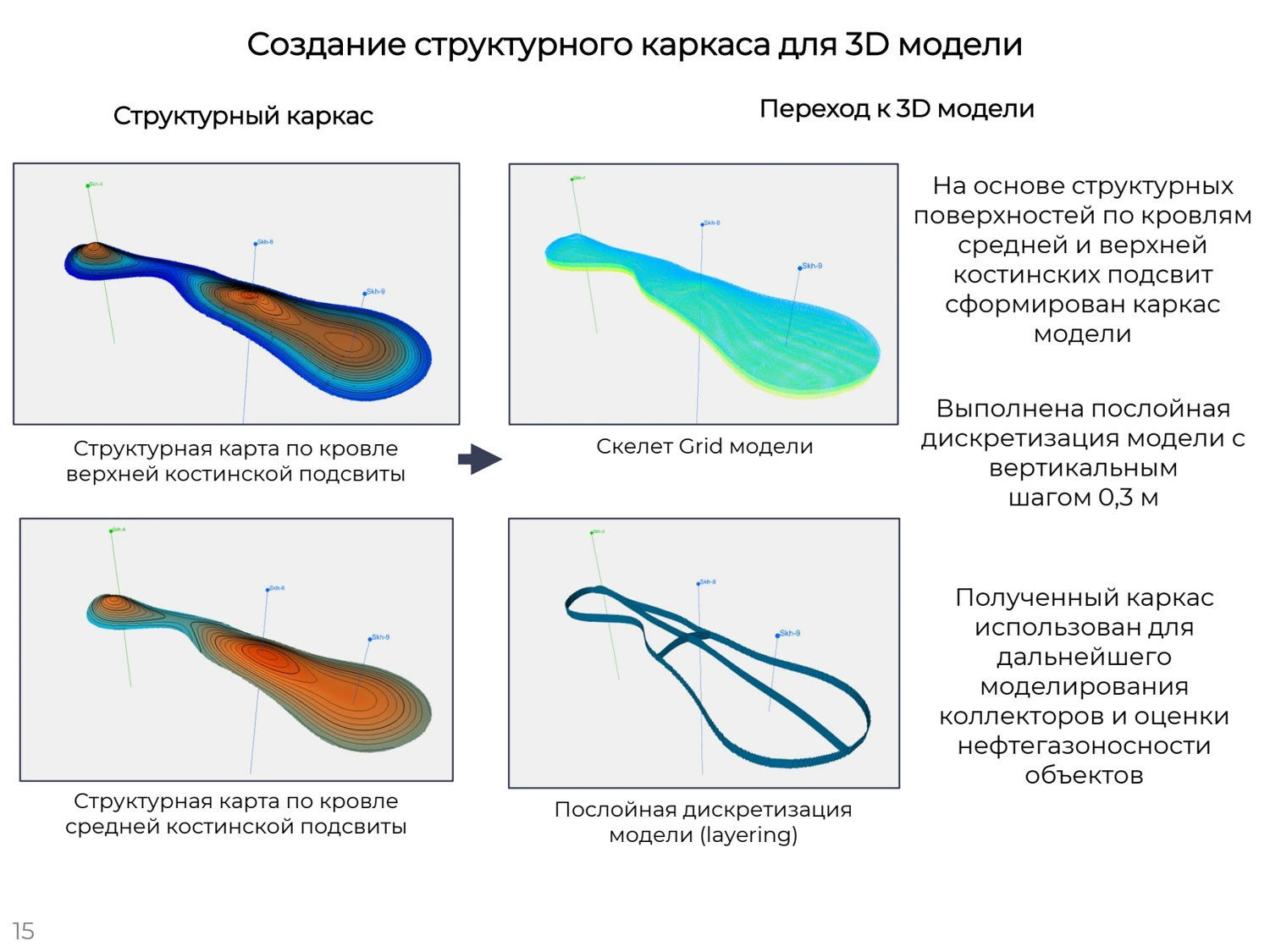
The left panels show structural maps for the tops of the Upper and Middle Kostinskaya units. The right panels show the grid skeleton and its vertical layering. The corner-point grid uses 0.3 m layers to represent the carbonate reservoir for property modeling and volumetric calculations.
Gas–water contacts
The log and test panels compare the Podkamennoye Uplift with the Gorny Dome. Their interpreted gas–water contacts are −568 m and −704 m SSTVD, respectively. The 3D view shows separate contact surfaces bounded by their structural closures. The interpretation uses the available evidence locally for each structure.